
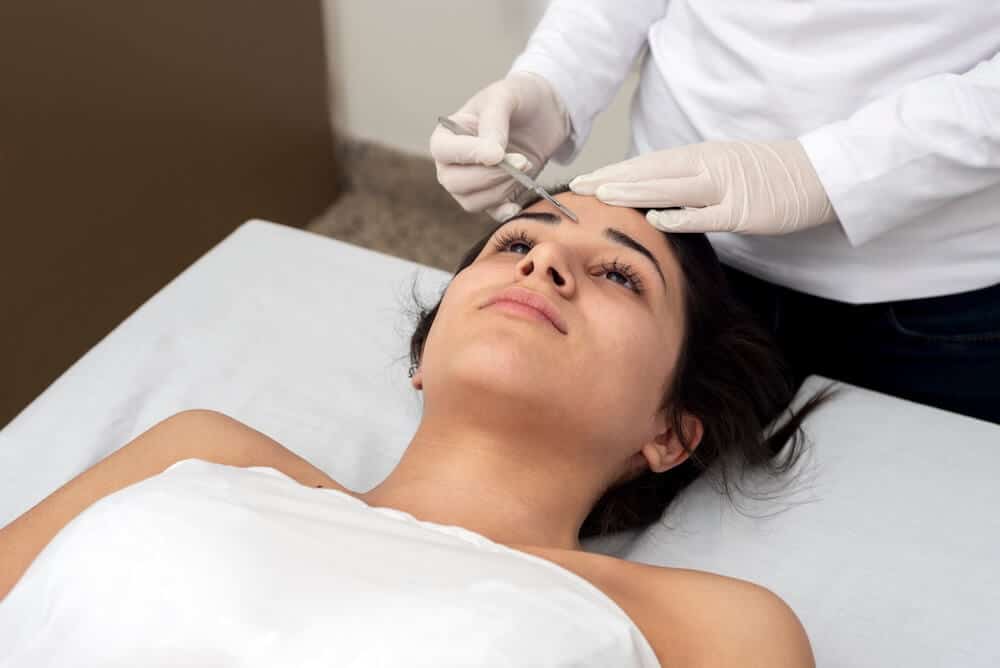
No, dermaplaning does not make facial hair grow back thicker, darker, or faster. It is one of the most persistent myths in skincare, and it keeps people from trying a treatment that could give them the smoothest skin of their lives. The short version: the blade never touches the part of your body that decides what kind of hair you grow. The long version is below, and it is worth two minutes, because once you understand how hair actually works, the fear disappears for good.
Where the Thicker Hair Myth Comes From
The myth is built on a real sensation and a wrong conclusion. When a hair grows naturally, it tapers to a fine, soft point at the tip. When any blade cuts a hair, whether during shaving or dermaplaning, it slices straight across the shaft and leaves a blunt edge. As that blunt edge grows out over the following days, it can feel slightly different under your fingertips than the tapered hair did.
Your fingers notice the change in the tip and your brain concludes the whole hair got thicker. It did not. The hair shaft is exactly the same diameter it always was. You are feeling geometry, not growth. Within a week or two, as the hair lengthens and softens, even that sensation fades.
The same misunderstanding has followed shaving around for generations, and researchers have tested it repeatedly going back nearly a century. Study after study has measured regrowth after cutting and found no change in thickness, color, or growth rate. Dermaplaning is subject to the same biology. Mayo Clinic's dermatology guidance says it plainly: shaving does not change hair's thickness, color, or rate of growth, and a blade at the surface is a blade at the surface.
Vellus vs. Terminal Hair: What Your Face Actually Grows
Your body grows two kinds of hair. Terminal hair is the thick, pigmented hair on your scalp, brows, and, for men, the beard area. Vellus hair is the fine, soft, nearly colorless fuzz that covers most of the face and body. That peach fuzz is what dermaplaning removes, along with the layer of dead skin cells sitting on the surface.
Whether a follicle produces vellus or terminal hair is decided by hormones, primarily androgens, acting on the follicle itself, which sits well below the surface of the skin. A blade gliding across the surface has no way to reach the follicle, no way to change its hormone sensitivity, and no way to convert a vellus follicle into a terminal one. That conversion only happens through hormonal shifts, such as puberty, pregnancy, menopause, or certain medical conditions and medications.
"This is the first question almost everyone asks before their first dermaplaning treatment, and I love answering it. The science is completely on our side. We are simply lifting away what your skin has already finished with. Nothing about your hair changes except that it is gone for a few weeks."
Victor Thompson, Owner, Greentoes
What Regrowth Really Looks Like, Week by Week
In the first few days after your treatment, your skin stays completely smooth. Vellus hair grows slowly, so there is nothing to feel or see. Somewhere in week two, the fuzz begins its quiet return, and this is the window where a few people swear it feels stubbly. What they are feeling is the blunt-cut tip described above, at its shortest and most noticeable stage.
By week three, the regrowing hairs have lengthened and softened, and your face feels the way it did before your appointment. By week four, regrowth is complete, which is exactly why estheticians recommend dermaplaning on a three to four week cycle. The hair does not come in patchy, it does not come in darker, and it does not come in coarse. It comes back as the same soft vellus fuzz it has always been.
What Dermaplaning Actually Changes
The real transformation has nothing to do with hair at all. Professional dermaplaning removes the buildup of dead skin cells that dulls your complexion, softens the look of dry patches and fine lines, and clears the fuzz that keeps foundation from sitting smoothly. Skincare products absorb better because they are no longer fighting through a barrier of dead cells. Most clients notice brighter, more radiant skin the moment they leave the treatment room.
The treatment is performed on the face only, steering clear of delicate areas like the eyelids, and takes about thirty minutes. Many clients fold it into a facial, such as the Refining Signature Facial, which pairs dermaplaning with a customized treatment chosen during your consultation.
It is also worth noting who has been quietly using this treatment for decades: makeup artists and their clients. Dermaplaning has long been a backstage staple before photo shoots and weddings precisely because it creates the smoothest possible canvas. If the thicker-hair myth were true, the people whose faces are photographed for a living would have abandoned the treatment generations ago. Instead, they book it on repeat.
"Our clients who dermaplane regularly are not doing it for the hair. They do it because their skin glows for weeks afterward and their moisturizers finally get to do their job. The peach fuzz coming off is honestly just a bonus."
Victor Thompson, Owner, Greentoes
Common Questions About Hair Regrowth After Dermaplaning
Q: Can dermaplaning cause visible stubble on a woman's face?
A: No. Vellus hair is too fine and too light to create visible stubble. The brief blunt-tip stage in week two can sometimes be felt with your fingertips, but it is not something anyone can see, and it softens on its own as the hair lengthens.
Q: Does everyone's hair grow back at the same speed?
A: Regrowth speed varies slightly from person to person based on genetics and age, but almost everyone lands in the two to four week range. Your own pattern will be consistent from treatment to treatment, which makes scheduling easy.
Q: Could dermaplaning ever cause darker hair in one spot?
A: Not from the treatment itself. If you ever notice genuinely darker or coarser hair appearing on your face, that is a hormonal signal worth mentioning to your doctor, because surface exfoliation cannot cause it.
The Bottom Line on Dermaplaning and Hair Regrowth
Your hair follicles never meet the blade, so nothing about your hair can change. What does change is everything above the follicle: smoother texture, brighter tone, flawless makeup application, and skincare that finally absorbs the way it should. The thicker-hair myth is the only thing about dermaplaning that deserves to be scraped away for good.
If you have been holding off because of the regrowth myth, consider this your green light. A thirty minute appointment at Greentoes will show you what your skin looks like without the fuzz and the buildup, and in three to four weeks the only thing that returns is the same soft peach fuzz you started with.